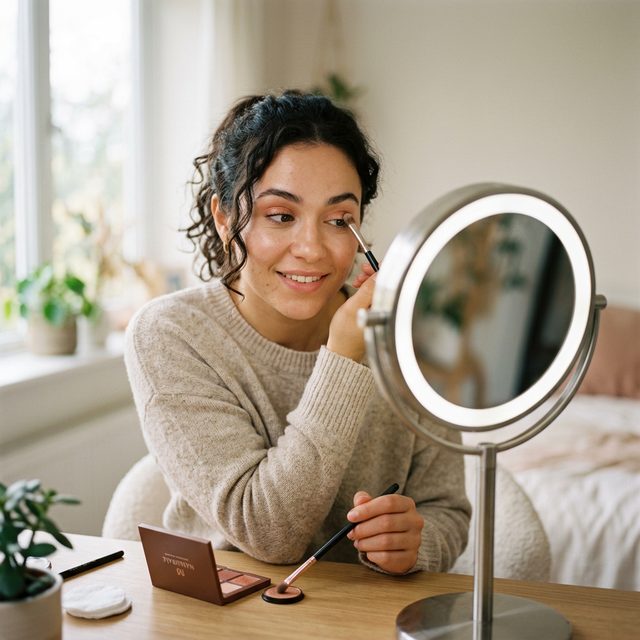
Starting with eyeshadow feels overwhelming because there’s so much conflicting information online. This guide cuts to what actually matters for beginners: the minimum-viable toolkit, the easiest entry-point looks, and a simple process that builds skill fast.
This page is the starter kit: what to buy first, what can wait, and the first looks that forgive mistakes. The step-by-step formula guide picks the first shadow type. The 5-zone application order is the placement sibling. All three URLs stay live.
What You Actually Need to Start
Palettes
Start with one palette that has matte shades in neutral tones. Neutrals are the most forgiving, most wearable, and most teachable, once you can blend neutrals, colors become easy.
Recommended starting palettes:
- NYX Professional Makeup Ultimate Shadow Palette (~$18), 16 shades, mix of matte and shimmer, very forgiving formula
- e.l.f. Bite-Size Eyeshadow (~$10), smaller, more focused, easier to manage
Beauty Desk listing check: NYX Ultimate has several colorways — Warm Neutrals is the beginner-safe one, Brights is not. e.l.f. Bite-Size listings are quads, not singles; confirm the color story on the thumbnail. Prefer new stock.
Brushes
You need exactly two brushes to start:
- A large fluffy dome brush, for blending (Real Techniques Blend + Define, ~$10)
- A flat shader brush, for packing color onto the lid
That’s it. You can expand later. More brushes don’t make you better, technique does.
Primer
Urban Decay Eyeshadow Primer Potion ($26) or e.l.f. Eye Primer ($8). One small pump, entire lid. Makes every shadow perform better and last longer.
Your First Look: The One-Shade Eye
Before blending multiple colors, master the single-shade look.
Steps:
- Apply primer to the entire lid, let it dry 30 seconds
- Load your flat shader brush with a mid-tone matte shade
- Press (don’t drag) onto the lid from inner to outer corner
- Take the fluffy blend brush and soften the edges, short back-and-forth motions
- Apply mascara
This is the foundation of everything. Master the softening step before moving to multiple shades.
Your Second Look: Three-Shade Neutral
Once you’re comfortable with one shade, add two more:
- Light shade: All over the lid and brow bone
- Mid-tone: In the crease (the fold above the lid)
- Dark shade: Outer corner only, blended inward
Steps:
- Light shade all over the lid, broad sweeping motion with fluffy brush
- Mid-tone shade into the crease, back-and-forth blending motion
- Dark shade on the outer third of the crease, blended toward the center
- Clean fluffy brush over everything to soften
- Add mascara
The secret: Less is more. Start with lighter pressure and build up. You can always add more shadow, you can’t easily remove it.
Most Common Beginner Mistakes
Too much product. Tap your brush on your hand before applying. The amount you think you need is usually double what you actually need.
Not blending enough. Any harsh lines mean more blending. Keep going with the fluffy brush until you can’t see where one shade ends and another begins.
Using shimmer shades in the crease. Shimmers are for the lid (center). Mattes go in the crease for clean blending. Shimmer in the crease creates a glittery, muddy result.
Skipping primer. Shadow without primer creases within an hour on most eyelids. Primer takes 30 seconds and solves the problem completely.
Starter Brush Kit
| Brush | Use | Budget Option |
|---|---|---|
| Large fluffy dome | Blending everything | Real Techniques (~$10) |
| Flat shader | Packing color on lid | e.l.f. shader (~$4) |
| Small fluffy | Crease (optional later) | Any budget set |
Related reads:
- Eyeshadow Placement Guide
- Eyeshadow Blending Techniques
- How to Stop Eyeshadow Creasing
Choosing the Right Product for Your Needs
When exploring eye makeup, selecting the perfect product relies heavily on understanding your skin type, undertones, and daily routine. To achieve the most flattering look, always prioritize formulas that work with your unique biology rather than against it.
Understanding Skin Types and Formulas
If you have oily eyelids, powder eyeshadows and waterproof liquid liners will be your best defense against midday creasing and smudging. For those with mature or dry skin, cream shadows and hydrating concealers offer a youthful, radiant finish that won’t settle into fine lines. Always start with a high-quality eye primer to ensure whatever formula you choose locks in place for 12+ hours. Also, applying setting powder lightly over the lids before packing on color can absorb excess sebum throughout the day, significantly extending the life of your look.
The Role of Undertones
Matching your makeup to your undertone is crucial. If you have cool undertones (veins appear blue/purple), reach for icy silvers, cool taupes, and berry hues. If your undertones are warm (veins appear green), gold, peach, bronze, and warm terracotta shades will make your eyes pop. Neutral undertones have the flexibility to wear almost any shade on the color wheel. Remember that contrasting colors on the color wheel create the most dramatic impact; for example, warm copper tones will make blue eyes appear vividly bright, while violet hues beautifully enhance green eyes or hazel eyes.
Proper Removal and Eye Health
The most important step of any makeup routine is removing it. Sleeping in eye makeup can lead to clogged hair follicles, lash loss, and severe eye infections like styes. Use a dedicated, gentle bi-phase makeup remover on a cotton pad, holding it over the closed eye for 10 seconds to dissolve waterproof bonds before gently wiping away. Never violently scrub the delicate skin around the eyes, as this accelerates premature aging and wrinkle formation. After removal, applying a hydrating, peptide-rich eye cream will restore the moisture barrier stripped away by cleansing surfactants, promoting healthy lash growth and a smoother canvas for the next day’s application.
Sources
- American Academy of Ophthalmology, Eye Health Information
- American Academy of Dermatology, Skin Care Guidelines
- National Eye Institute, Eye Health Research
Related Articles
- Smokey Eye Tutorial for Beginners
- Eyeshadow Blending Techniques
- Best Eyeshadow Palettes
- How to Make Eyes Look Bigger
- Eyebrow Shaping Guide
Frequently Asked Questions
How long does it take to get good at eye makeup? Most people see meaningful improvement within 2-4 weeks of daily practice. The key is practicing the same technique consistently rather than jumping between styles. Pick one look to master before moving on.
What’s the most important tool to invest in? A good blending brush is more impactful than any single eyeshadow product. Cheap brushes make even great eyeshadow look patchy and muddy. Look for dense, fluffy brushes in natural or synthetic fibers, brands like Real Techniques and EcoTools offer excellent quality under $20.
Should I apply eyeshadow before or after foundation? After foundation. Apply your eye makeup first if you prefer, this lets you clean up any fallout before finishing your base, but always set your eye area with primer and a light setting powder before starting eye makeup. This prevents creasing and extends wear.
Why does my eyeshadow fade or crease by midday? Without an eye primer, eyeshadow bonds to the natural oils in your skin rather than to the lid itself. Urban Decay Primer Potion, NYX Eyeshadow Base, and e.l.f. Eye Primer are all effective at extending wear to 8-10 hours.
Get weekly eye care & beauty tips
Guides from the Eyeshadow Looks Beauty Desk. No spam, ever.
Related Articles
 tutorials
 Best Eyeshadow for Beginners: Step by Step Guide
Read Guide arrow_right_alt tutorials
 How to Apply Eyeshadow for Beginners: Step-by-Step Guide (With Pictures)
Read Guide arrow_right_alt tutorials
 Smokey Eye Tutorial: Step by Step for Beginners
Read Guide arrow_right_alt tutorials
 Smokey Eye Tutorial for Beginners: A Foolproof Method
Read Guide arrow_right_alt tutorials
 Smokey Eye Tutorial for Brown Eyes: Colors and Steps That Actually Flatter
Read Guide arrow_right_alt tutorials